Reversible Sun Hat Sewing Pattern, Part 2

Welcome to part 2 of my sewing tutorial for a wide-brimmed, reversible sun hat with removable ties. If you haven’t already printed your pattern and cut your fabric, click here to hop over to part 1 of the tutorial.

Ready to start sewing? Let’s get going!

sun-hat-sewing-pattern-for-kids-adults
 

First, sew your lightweight fabric pieces together.

THREAD COLOR: For the rest of this pattern, “Thread Color A” refers to the thread that matches your lightweight fabric. “Thread Color B” is the thread that matches your medium-weight liner fabric.

For steps 1 to 11, use Thread Color A in both your top spool and your bobbin.

bias tape end finishing

Step 1a: Sew together your bias tape strips until you have two 30″ long pieces; then iron them into a double fold. This tutorial video shows you how to make double-fold bias tape.

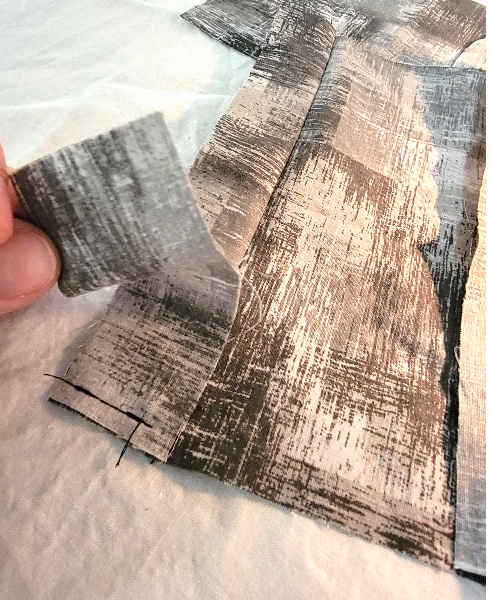
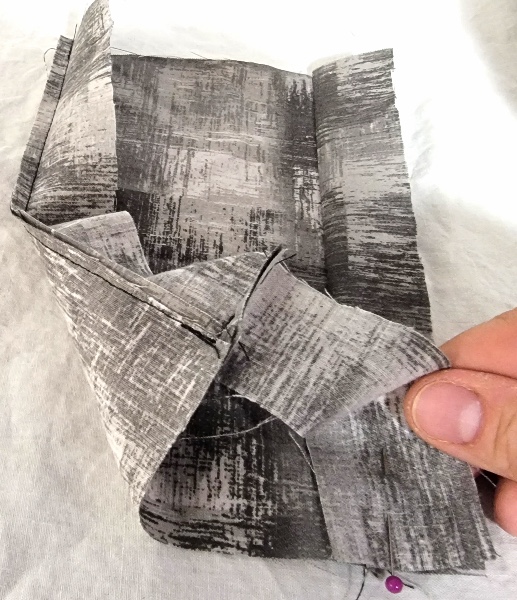
Step 1b: To finish the ends of each bias tape strip, first unfold the strip’s end and lay it flat. Fold each corner toward the center so that the fabric ends in a point. Fold the point down, and then refold the original double-fold of the bias tape. Do this folding to both ends of the strip.
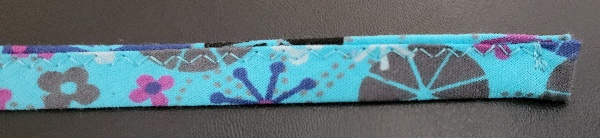
 

Step 1c: With the ends folded in, sew along your strips with a zigzag stitch. I use a width 2 (out of 5), length 3 (out of 5) zigzag stitch with my machine.

Once both strips are sewn, set them to the side. We’ll come back to these at the end for your hat ties.


Step 2a: Now grab the two rectangle shapes, which will be the hat loops for the removable ties. These are basically going to be folded and sewn like very short bias tape strips.

Step 2b: Fold both strips in half lengthwise and press with an iron.

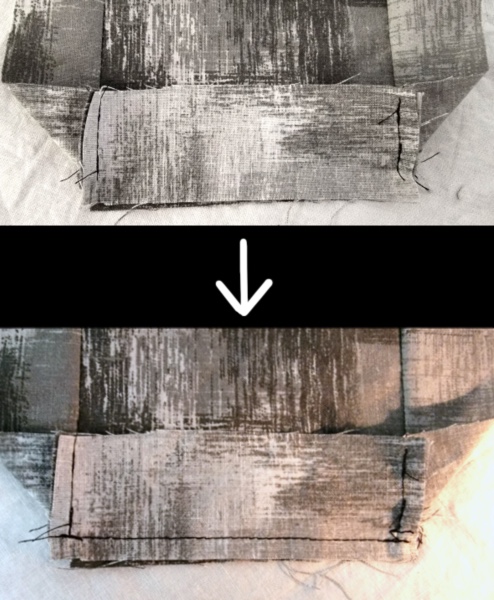
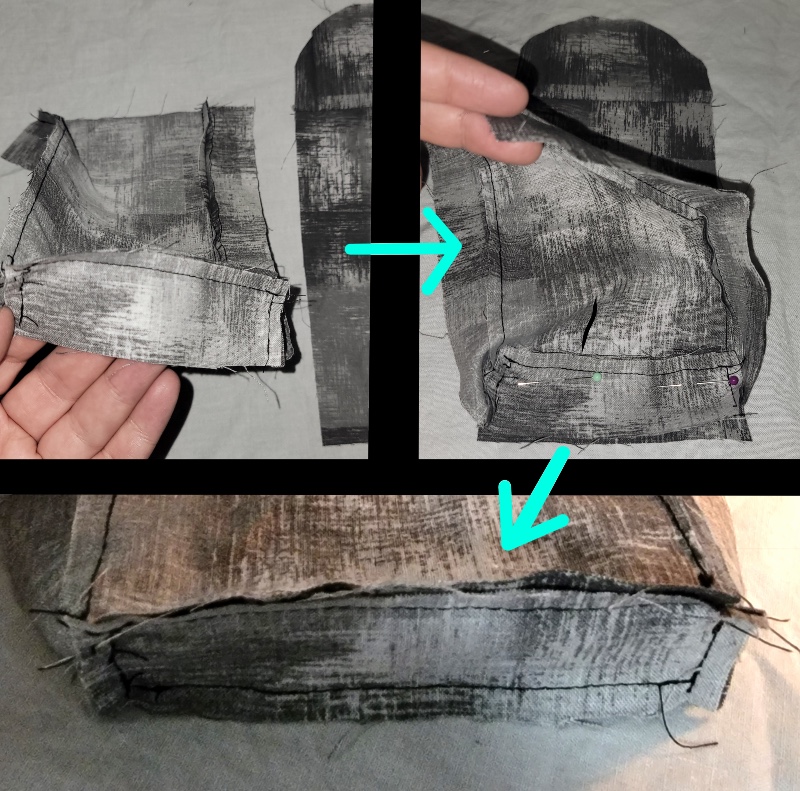
Step 2c: Unfold the strips. Use the crease that you created with step 2b as a guide. Fold the sides inward so that the edges meet in the center, as shown in the picture. Do this to both strips, and press the new creases with an iron.

Step 2d: Fold both strips in half again along the original crease from step 2b. Sew along the length of the strips with a zigzag stitch, width 2 and length 3, same as you did with the bias tape in step 1b. However, this time do not fold under or finish the ends. Leave them raw.


Step 3: With right sides facing, sew the 3 brim pieces together with 1/4 inch seam. Press the seams open with an iron, as shown.

Step 4: With right sides facing, sew the 3 crown pieces together with 1/4 inch seam. Press the seams open with an iron, as shown.

 
sun hat instructions

Step 5a: Fold the brim in half with one of the seams at the folded edge. The other two seams will lie flat and overlap each other, as shown in picture 5a.

Step 5b: Fold the brim in half a second time, as shown in picture 5b. There are now 2 layers of fabric folded on the left side. Place a pin in each layer on the fold, as shown, with one pin on the outside of the fold and the second pin on the inside of the fold.. Do not pin the two layers together! The purpose of these pins is to mark the exact centers on the left and right sides of the hat. (Alternatively, you can also make a mark with chalk.)

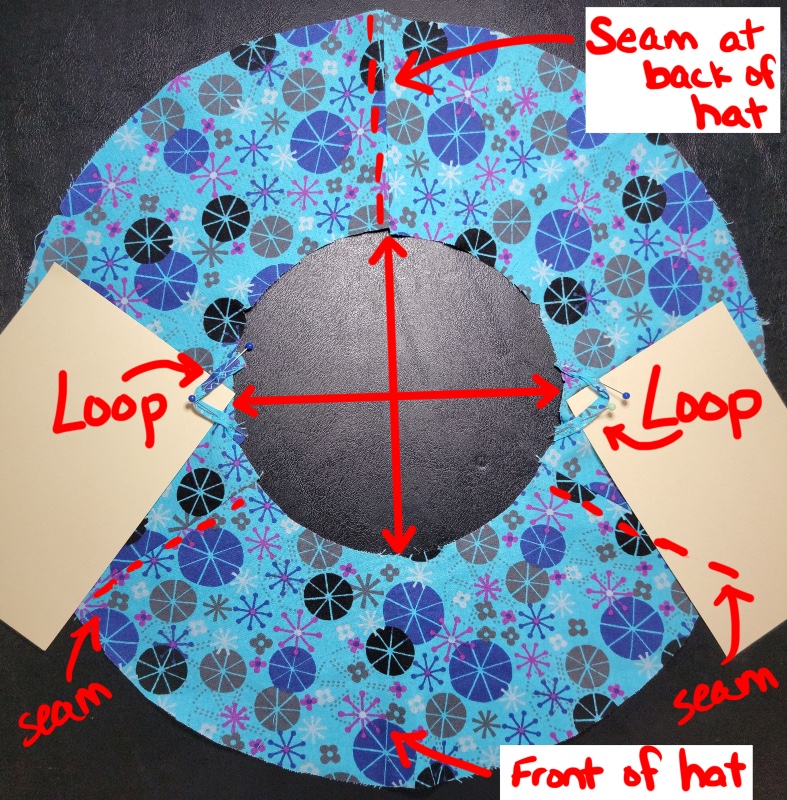
Step 5c: Unfold the brim all the way until it is a full circle again. Using the pins from 5b as markers. attach the loops to the right side of the brim as shown. The 5b pin marker should be at the center of the loop.
 
sun hat instructions

Checking in: This is how your brim should look right now. (I put some cardstock under the loops to make them easier to see.) Note that the back of the hat will have a seam, while the front of the hat will not have a seam. Keep this in mind as you start attaching sections in future steps.

Step 6: Sew 1/8 inch from the edge of the brim to attach the loops.

 
sun hat instructions

Step 7: Trim any excess loop so that its edges are flush with the brim’s edge.
 
sun hat instructions

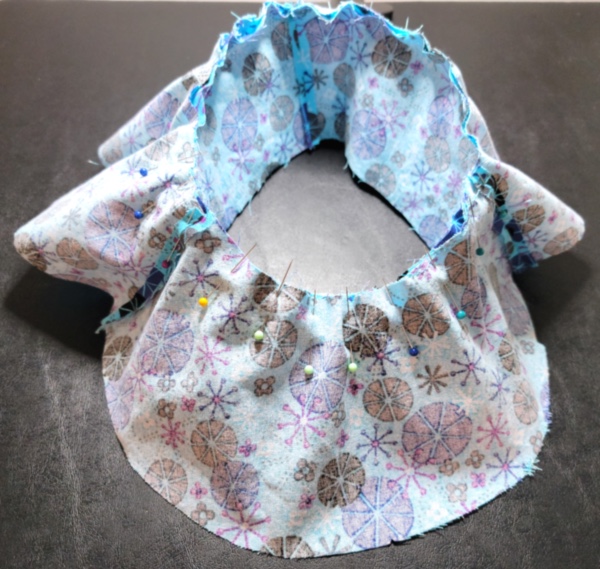
Step 8: With right sides together, pin the LARGER side of the crown to the SMALLER side of the brim, as shown. Be sure to match seams and notches to each other. Sew around with 1/4 inch seam.

 
sun hat instructions

Step 9: Press the seam from step 8 up toward the crown and topstitch it down. Make sure to push the loops toward the brim so they don’t get caught under the stitches. The topstitching should go all the way around the base of the crown, 1/8 inch away from the seam.

 
sun hat instructions

Step 10: Pin the circular top piece to the crown with right sides together, as shown. The double notch on the top piece should line up with the seam on the BACK of the hat (not either of the side seams). The other 5 notches on the top piece should line up with the remaining seams and notches on the crown. Sew all the way around, 1/4″ from the edge.

Advice: By putting your pins on the crown side, not the top, you’ll find it easier to avoid accidental fabric bunching while you stitch. Go slow on this round. I recommend pausing frequently to re-straighten your fabric as you work your way around.

 
sun hat instructions

Step 11: Press the seam from step 10 toward the crown, and topstitch it down. Topstitch all the way around, 1/8 inch away from the seam.


Now it’s time to sew the liner!

THREAD COLOR: For steps 12 to 14, use Thread Color B in both your top spool and bobbin.

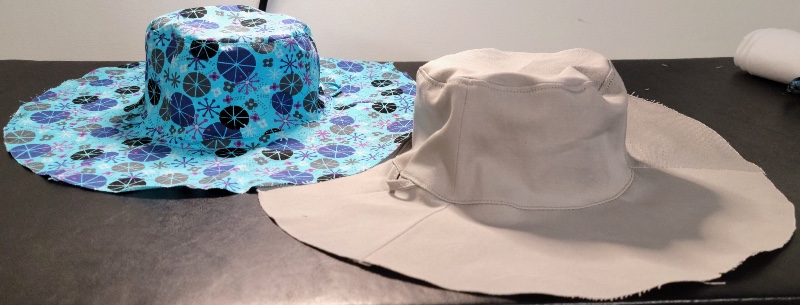
Step 12: Repeat steps 2 to 11 with your liner fabric. You will end up with the two halves of your hat, like the ones shown here.

You’re almost to the finish line now! Head on to part 3 of my sewing hat tutorial for instructions on how to put the remaining pieces together.
Reversible Sun Hat Sewing Pattern, Part 1

wide brim sun hat sewing pattern for kids and adults

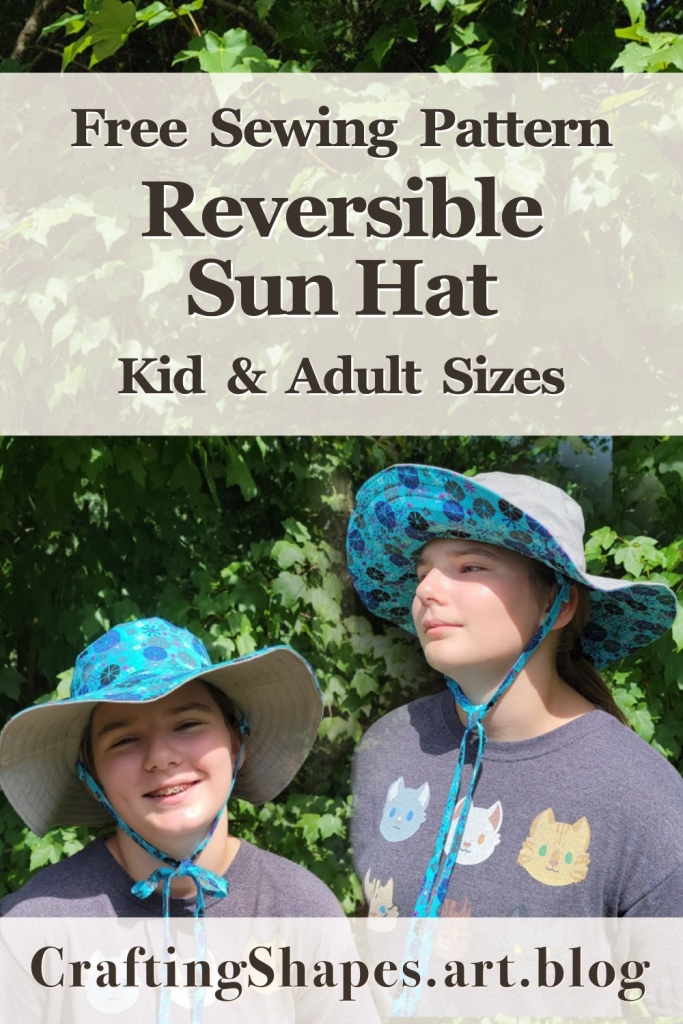
I own this marvelous sun hat that I bought at The Gap about 20 years ago. It’s a little big for my head, but it’s comfortable. More importantly, it has this amazing wide brim to keep the sun off my face, neck, and chest when I’m working in the mid-day heat. I’ve wanted to get similar hats for my kids, but I simply cannot find a reasonably priced hat that 1) fits their heads comfortably, 2) has a wide brim all the way around, 3) has a tie to keep the hat from blowing away, and 4) comes in a color or pattern that my kids will wear willingly. (That last one is extra tough when it comes to my teenage son!)

old sun hat
My 20-year-old sun hat really needed a replacement.

So I finally gave up and decided to make a hat pattern using my old hat as inspiration. The old hat was built from two half-circle arcs to create the brim. I opted to break the sides and brim into thirds, which makes it easier to use fabric with a directional pattern. The old hat didn’t have ties, either, so I added loops. This way, a tie can be added or removed, depending on how windy the day gets. Having loops instead of sewing the ties directly to the hat also makes it possible for the hat to be reversible.

Finally, I faced my biggest challenge: how could I give the hat a nice wide brim for sun protection, without the brim flopping down and covering the eyes? This was my biggest beef with my old Gap hat, actually. The solution came to me while I was organizing my kids’ craft bin. Felt! When I added a layer of inexpensive craft felt to the hat’s brim and then top stitched the brim in a faux-quilted method, the hat ended up with a Goldilocks “just right” balance of stiffness and floppiness.

And voila, the new sun hats are perfect! They came out so well, in fact, that other moms at the playground have been stopping me to ask where I bought them. I feel like one of the best compliments a seamstress can get is when people can’t tell your work is home made.


Prep Your Sun Hat Project: Tools & Materials Needed

  • Difficulty level: Intermediate
  • Total Cutting & Sewing Time: About 3.5 hours

You don’t need a lot of extra sewing notions for this project. Along with your sewing machine, pins, and tape measure, you’ll need the following materials…

  • Patterned side: 1/2 yard lightweight fabric. I use cotton quilting fabric. Two fat quarters of fabric can work just as well as a complete 1/2 yard piece.
  • Solid side: 1/2 yard medium-weight fabric. I use a polyester-cotton-blend twill fabric (the type that khaki pants are often made from).
  • Sewing thread in two colors, one to match each fabric. (As an alternative, you can use one color thread that matches one fabric and works as a contrast against the second fabric.)
  • Crafting felt – I use plain white felt. Three pieces of standard 9″x12″ craft felt will be plenty if you are making a hat sized 23″ or smaller. If you are making a hat for sizes 24″ or 25″, though, you will need to buy larger felt that can produce 3 pieces that are 9″ x 14″. (I buy my bulk felt as a single 1-yard piece from Michaels for about $4.)
  • Optional: Two sew-on snaps. This is to make the ties removable. If you don’t want to deal with snaps, you can also simply make a knot to attach the ties to the hat. I don’t recommend buttons or hooks, because hair can get caught in them.

The materials listed above will be enough for all the different hat sizes available in this post. Of course, if you are making one of the smaller hat sizes, you’ll end up with some leftover fabric – maybe even enough to whip up a small drawstring bag to match the hat. (But that is a pattern for another day…)


Measure Your Head & Print Your Pattern

To start, measure the head circumference of the person getting the new hat. Wrap a tape measure around the head, going just above the eyebrows and ears and going around the back at the widest point of the base of the head.

Don’t pull the tape measure too tight while measuring, but don’t worry about leaving any extra slack, either. The patterns include 1″ ease already. (In other words, the hat for an 18″ head is actually 19″ around its base.)
Once you know the circumference measurement of the head getting a new hat, go ahead and print the correct pattern size from the options below.


Pre-Shrink Your Fabric & Cut Your Pieces

I really cannot emphasize this enough: Run your fabric and felt through the washing machine and dry it on high temperature to shrink the fabric down as much as possible before you cut the pieces. There is nothing worse than putting a lot of energy into sewing something, only to have it shrink in the wash and not fit anymore.

Once you have pre-shrunk your fabric, go ahead and cut out the pieces as directed in the pattern. In addition to cutting the pattern pieces that you print, you also need to cut enough diagonal 2-inch-wide strips to make about 2 yards of 1/2-inch double-fold bias tape. (There’s a great video on how to cut and sew your own bias tape here.) You only need to cut your bias tape strips from the lightweight patterned fabric. Do not cut bias tape strips from your liner fabric.

Here is one possible layout for cutting your fabric from a half-yard of 45″ fabric. (Keep in mind, this layout shows the largest hat size of 25″. For smaller hats, you’ll end up with more leftover fabric and may even want to arrange the pieces differently as you cut.)

If you buy your fabric as two fat-quarter squares, this cutting layout will work better for you. Note that the top and bottom edges are 22″, and the side edges are the shorter 18″ edges of the fat quarter.

Last but not least, cut your felt. As I mentioned above, you should have no trouble cutting from a standard 9″ x 12″ piece of felt if you are making hat sizes 18″ through 23″. If you are making size 24″ or 25″, though, your felt pieces will need to be bigger.


Phew! Are you finished with that prep work? Then head on to part two of this post, where I explain how to sew all the pieces together!

Cell Phone Satchel, Part 2 – Sewing Pattern

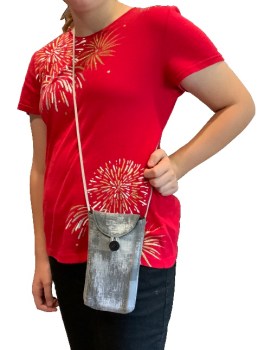
cell phone bag

If you are here, then you should have already finished the instructions in part one of this cell phone satchel sewing pattern. If you have not already done part one, you can find it here.

All right, let’s dive back into these instructions!


Start Putting All the Pieces Together!

satchel instructions

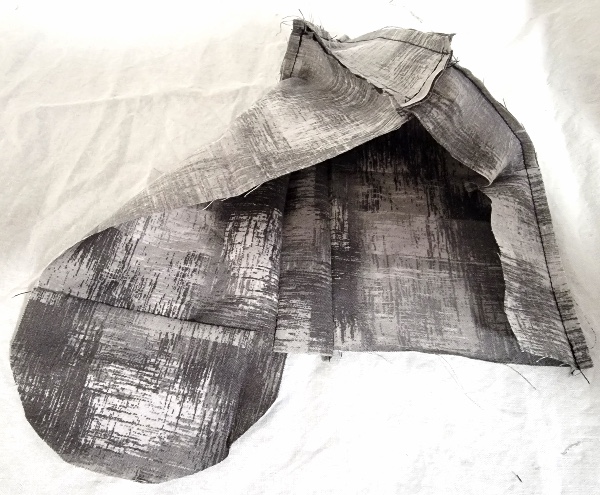
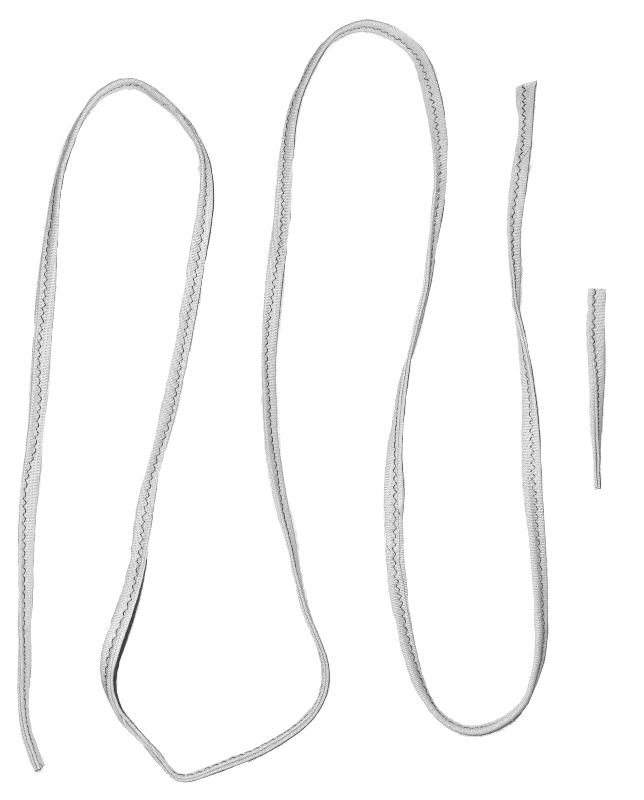
At the end of step 10 in part one, your main fabric and your liner look like this. You should also have your two pieces of bias tape for the strap and button closure, with zigzag stitching along their lengths.


satchel instructions

Step 11 : Sew the ends of the bias tape strap to the right side of the felt liner, as shown. The strap ends should be attached at the center of the side panels, and the stitching should be 1/8″ from the edge. Before you sew, make sure the strap is not twisted!

Step 12: Sew the ends of the button-closure bias tape to the center of the top panel, on the right side of the fabric, as shown. The ends should not overlap but should be right next to each other. As with the strap in step 11, sew 1/8″ from the edge.

satchel instructions

Step 13: Pin the top edge of the main fabric and the liner with right sides together, as shown. Be sure to match up any seams or corners as closely as possible.

Important: Pull the bias tape strap and button closure between the two fabric layers and away from the edge. Keep them positioned flat and fully perpendicular to the edge you’re about to sew. You don’t want a wonky button loop!

Sew along the entire top edge, as shown with red arrows in this photo. (I have marked start and end points, but it doesn’t really matter which side you start on.) When you reach the midpoint where you have to turn a 90-degree corner, leave your needle in your fabric, then raise your presser foot, turn the fabric, lower the foot again, and continue stitching.


satchel instructions

Step 14: Clip the edges of the curved fabric, as shown. Clip close to the stitch line, but be careful not to cut the stitching itself!

This will help the curved seam lie flat when you turn the bag right side out.


satchel instructions

Step 15: Separate the liner from the main fabric. Pull the top curved flap upward, and pull the bottom panels away from each other, as shown. Do not turn the bag right side out! The bias tape should be inside the fabric layers, as you can see in the photo.


satchel instructions

Step 16: With the main fabric and liner still pulled apart from step 15, sew closed the remaining side seam of the main fabric. The stitching must stop when it reaches the seam at the base of the curved flat. I’ve marked this stopping point with an arrow in the photo.


satchel instructions

Step 17: Repeat step 16 on the liner, but leave a 3 inch gap in the middle. (It’s hard to see in the photo, but the main fabric is still separated from the liner and pulled away to the right.)

Note: I recommend the gap be centered like this instead of down at one of the corners. By machine stitching on both sides of the gap, you ensure a neat, tightly closed corner. You don’t want a hole opening up later at the bottom of your bag’s liner!


satchel instructions

Step 18: Now for an exciting step! Turn your bag right side out, using the gap you left in the liner. Keep the main fabric and liner separate for now, as shown in the picture. Using a tool such as a chopstick, gently push out the corners and curves as much as possible.
Sew the liner gap closed now by folding the edges in 1/4″ and pinning them. (I like to use a safety pin so I don’t stab myself, but a straight pin is also fine.) Now when I do this, I don’t pin the two sides together; I find the felt to be too bulky for that. Instead, I fold one edge under 1/4″ and pin that fold. Then I fold the other edge in 1/4″ and use a second pin on that.

With the two sides folded under, I then hold the two sides together with one hand and sew the gap closed with the other. I like to use a slip stitch for this step, but a whip stitch is also perfectly fine.


satchel instructions

Step 19: You’re on the home stretch! Push your liner inside the main fabric. Make sure the top seam where the liner meets the main fabric is pulled taut as much as possible. You can tug gently on the bias tape straps and the button loop to help shape the seam edge. Then pin the seam into place, as shown, all the way around the bag’s opening.


satchel instructions

Step 20: Sew a line of topstitching all the way around the opening of the bag, 1/8 inch from the outer edge. You can two different thread colors in your main spool and bobbin to match your main fabric and liner fabric, respectively. Or you can do what I did, and use your liner color on both sides to add some contrast color to the top of your bag.


satchel instructions

Step 21: The only step left now is to add your button. Close your top panel over the bag. Put your fabric chalk through the button loop and make a mark where you want the loop positioned when the bag is closed.

Open the bag again and, with the button loop moved out of the way, sew your button to the front of your bag. The button center should be directly over the chalk mark you made.


satchel instructions

And that’s all she wrote!

If you’re like me and want your bag to hang at different lengths depending on your activity of the moment, you can put a simple knot near the top of the strap to shorten it. Then untie the knot when you want the strap longer again.

If you gave this pattern a try, let me know in the comments how your cell phone bag came out. I love pictures, too!


free sewing pattern for cell phone bag

Cell Phone Satchel, Part 1 – Sewing Pattern

cell phone bag

I’m back and ready to share some new patterns, now that the insanity of pandemic life has abated a little. Which is to say, finally I don’t have to monitor distance learning for three of my kids while the fourth kid transforms her terrible twos into an art form. I’ve never been so excited for summer break!

Speaking of “breaks”, I broke my cell phone this month. It happened in such an annoying way, too. I took a post-dinner walk with my kids, and I was holding my phone in my hand at my side. I guess I loosened my grip a bit, because the phone slipped through my fingers and landed face-down on the road. Smash.

Why was the phone in my hand? Whelp, sadly none of my pants have pockets big enough for my Sasquatch-sized phone, and I definitely don’t want my mega mom purse on my shoulder when I’m relaxing outside. What I needed was a small bag just big enough for my phone. A bag that won’t slip off my shoulder when I lean over to pick up my toddler or kneel to pull garden weeds.

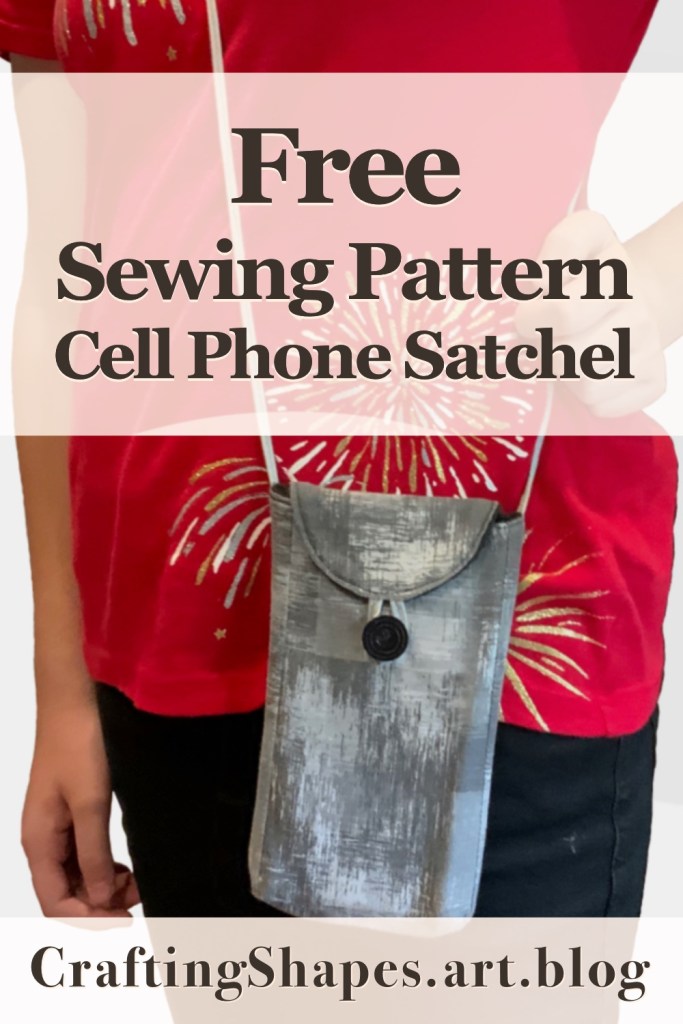
With that in mind, I whipped up this little bag to protect my phone. The entire project took about two hours, including fabric cutting time. The strap is long enough to wear diagonally across my shoulder. I can also easily adjust the length of the strap with a quick knot, so the bag can hang higher or lower depending on my activity of the moment. The interior is lined with craft felt, which adds a little extra protection if the bag bumps into something.

Since this post is a bit lengthy AND photo heavy, I’m splitting it into two parts. So without further ado, here goes part one!


Tools & Materials Needed for Your Cell Phone Satchel

First, of course, you’ll need to print the pattern.

Click here to download the PDF pattern for this cell phone satchel.

This pattern is for a bag with the finished dimensions 7.5 inches tall, 4 inches wide, and 1 inch deep. (Seriously, my cell phone is a beast.)

You will need the following materials…

  • Decorative fabric for outside of bag: one piece 8.5 by 18.5 inches. I recommend a cotton quilting fabric. This will be enough for your cell phone bag, even if your fabric has a directional pattern. This is about half of a fat quarter (one of those pre-cut squares of fabric you see in Walmart’s craft aisle).
  • Felt for bag lining: 2 pieces of 9 x 12 inch felt from the craft aisle will be more than enough. I used black felt for my lining, but you can pick whatever color you think compliments your main fabric the best.
  • Approx. 5 feet (the example pictured used exactly 63 inches) of 1/4-inch double fold bias tape (You can also get 1/2-inch single fold bias tape and fold it in half to make 1/4-inch double fold tape.) – You can make your own tape from the same fabric as your bag’s exterior, or you can buy pre-made double fold bias tape in a color that matches or compliments your bag’s main fabric. If you opt to make your own, you will need about 1/4 yard of your main fabric to have enough for your pattern pieces and your bias tape.
  • Sewing thread in two colors – one to match your main fabric, and one to match the color of your felt.
  • One button – The button size can be based on your personal preference. I used a 3/4-inch button on my purse.

For tools, you really just need the basics…

  • Sewing needle – You’ll need this even if you use a sewing machine for most of the stitching. The sewing needle will come in handy to put on your button and also to sew a small section of your bag closed when you turn it right side out.
  • Pins – Pinning your fabric together before sewing can certainly help ensure that your fabric pieces line up correctly.
  • Iron – Don’t skip this, especially if you are making your own bias tape!
  • Sewing machine (optional) – There is no reason you can’t sew this entire project by hand with a basic backstitch, but the instructions I give will be for a sewing machine.

Prepare and Cut Your Fabric

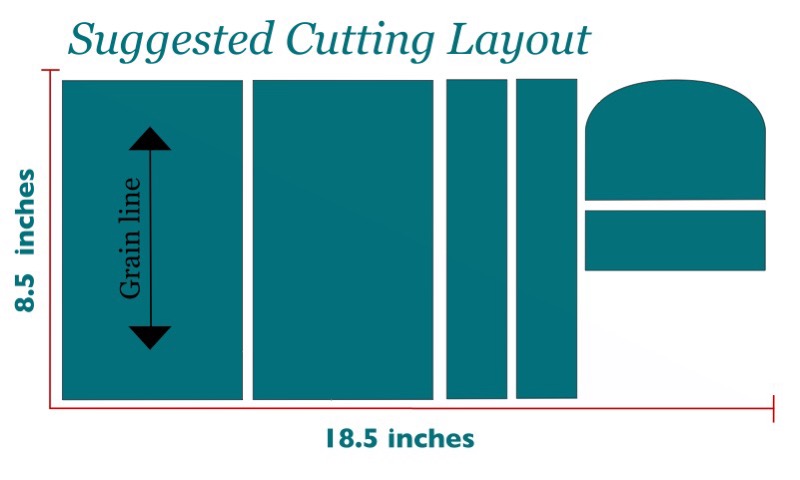
Once you have printed your cell phone bag pattern, it’s time to start cutting. The suggested cutting layout below is for your main fabric. It will work on both a fat quarter or on a quarter yard of 45 inch wide fabric. Either way, it will use approximately half of your fabric if you have a quarter yard. Make sure to pay attention to the direction of the grain line, especially if your fabric has a directional pattern on it.

cutting layout for bag sewing pattern

If your felt is in the typical size of 9″ x 12″ pieces, then you can cut the front and back panels from one piece of felt, and cut the rest of the pieces from the second piece of felt.


Sew Your Main Fabric

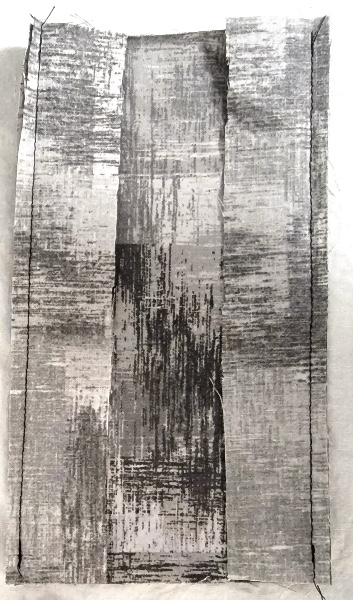
Step 1: With right sides facing, sew both side panels to the front panel, as shown. Note well: All the sewing lines in this pattern use 1/4 inch seam.


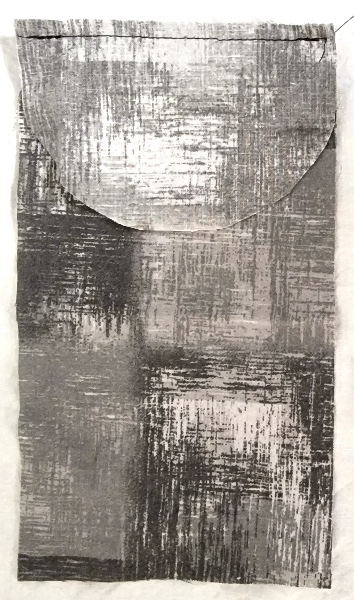
Step 2: With right sides facing, sew the top panel to the back panel.


Step 3: With right sides together, match up the short side of the bottom edge with the short side of a side edge. Notice that the outside corners line up completely, but the inside corner of the bottom piece extends 1/4 inch past the seam line from step 1. Important: your stitching should go all the way to the outer edge, but at the inner edge, it should NOT go past the seam line from step 1, instead stopping 1/4 inch from the inner edge.


satchel instructions

Step 4: Keeping right sides together, guide the bottom panel so that its other short edge lines up with the short edge of the second side panel. As in step three, the outside corners of the two pieces should line up. The stitching should go all the way to the outside edge, and it should once again stop 1/4 inch from the inside edge of the bottom panel, not extending past the stitch line from step 1.


satchel instructions

Step 5: Gently tug the seams and corners until the bottom panel lies flat against the front panel, with their long edges lined up. Sew the panels together, with the stitch line stopping at the seams from steps 3 and 4, about 1/4 inch from each end.


Step 6: Make sure all seams are pressed away from the bag center and toward the outside edges. With right sides together, pin the final edge of the bottom panel to the bottom edge of the back panel. Sew the panels together, stopping at the seams from steps 3 and 4, about 1/4 inch from each end.


satchel instructions

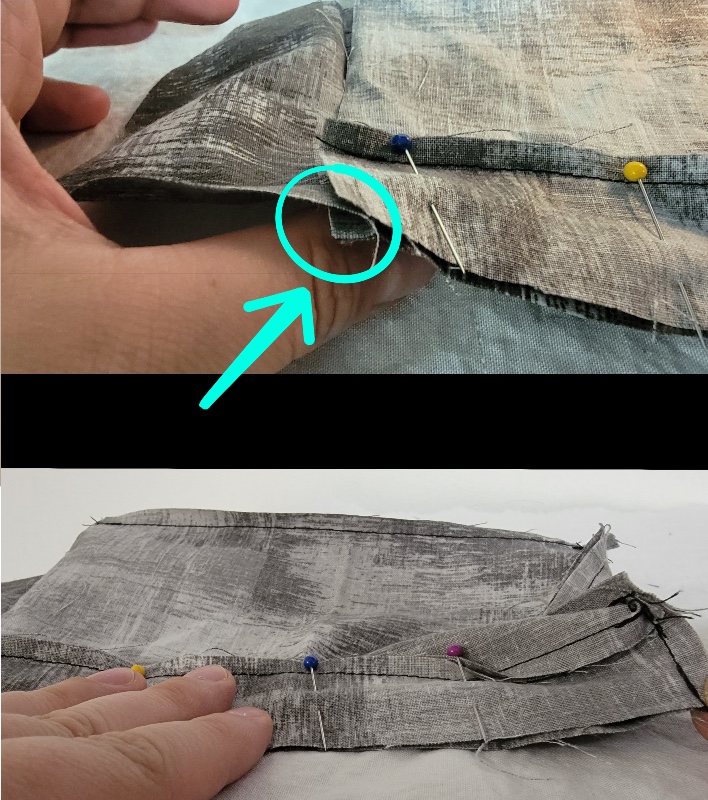
Step 7: Now it’s time to sew the side of the bag. Pin the long edge of the back panel to the long edge of one side panel. Be sure all seams are pressed away from the center. The top corners should line up, as shown in the circled part of the picture. Sew all the way to the top edge, but stop 1/4 inch from the bottom edge.

Important! Only sew one side of the bag in step 7. Leave the second side open for now.


satchel instructions

This is how your bag should look at this point.


Cut and Sew Your Bias Tape

Step 8: Cut two pieces of double folded bias tape.

The first piece should be about 4 to 5 feet long for the shoulder strap. The length you cut depends on how low you want your bag to hang. Include 1/2 inch for seam allowance.

The second piece will be your button loop. It should be long enough that it will easily fit around your button when the ends are pinched together to make a circle. Also include 1/2 inch seam allowance to this piece.

For the bag pictured, I cut a 5-foot piece (60 inches) for the shoulder strap, and I cut a 3-inch piece to fit around my 3/4 inch button.


satchel instructions

Step 9: Sew along the entire length of both pieces of bias tape. Use a slight zigzag stitch, so your thread maintains a small amount of stretch. In my bag, I sewed with a stitch length of 3 (out of 5) and a stitch width of 2 (out of 5).

Do not fold the ends of the bias tape when sewing. By leaving the ends raw, they will be easier to attach to the bag. The raw ends will get hidden when sewn to the bag later.


Sew Your Felt Liner

satchel instructions

Step 10: Set aside your main fabric for the time being. Repeat steps 1 through 7 with the felt liner panels. Important: When you reach step 7, sew the opposite side from the one you stitched with your main fabric.

When you finish step 10, your main fabric and liner felt should look like this picture, with opposite sides left open.


Start putting all the pieces together in part two!

Are you ready to jump into part two and finish sewing your cell phone bag? Click here to jump into the second part of this sewing tutorial.

Amazing Heart – Baby Onesie Embroidery Pattern

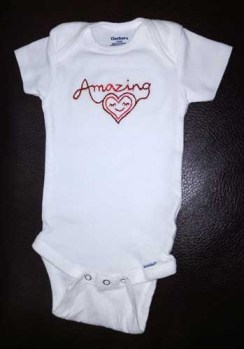
amazing baby onesie

Keeping with the theme of my previous post, I’ve been sketching up and stitching more quick weekend project patterns to embroider onto baby onesies. I like this one, because it can be whipped out extremely quickly without having to switch between colors (a tough thing to accomplish when there’s a baby on me while I’m stitching!)

Click here to download a PDF of the “Amazing Heart” embroidery pattern.

Or click here to download the pattern as a mirror image.


Tips & Tricks for Embroidering “Amazing Heart” onto a Onesie

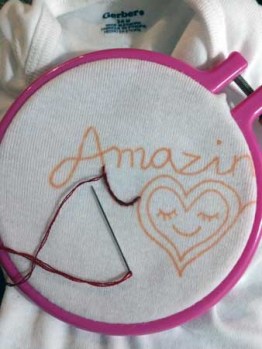
stem stitching

Once again, I opted to stitch this entire pattern in stem stitch, in part because I simply love this easy stitch, and in part because the stem stitch leaves less thread on the backside of the fabric. This is important when you want to avoid thread chafing against your baby’s skin!

I also used two layers of fusible interfacing on the back of the fabric. I ironed the first layer onto the onesie BEFORE I began to stitch. This helps to keep the fabric from stretching out of shape while I work with the thread.

Next, I ironed a second layer of interfacing onto the onesie AFTER I finished stitching. This holds the stitching in place better and also makes the inside of the onesie smoother feeling for baby. Here’s what the back of the fabric will look like when finished…

interfacing on back of fabric

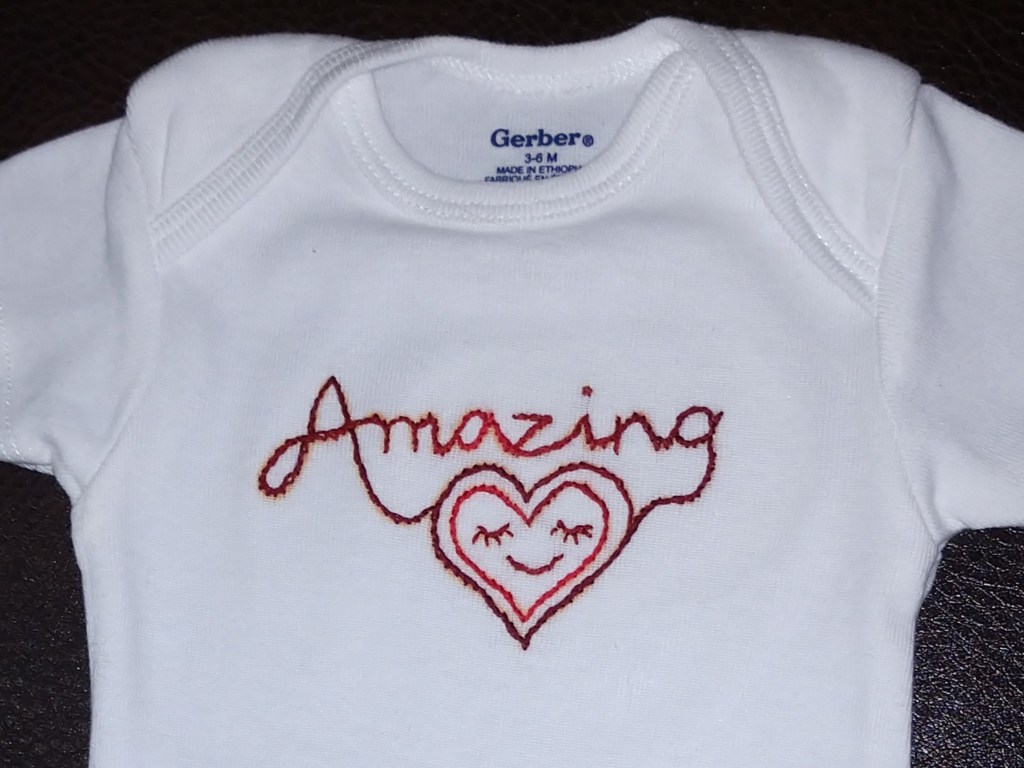
I tried out this pattern with a variegated red thread. In order to keep the changing red hues aligned well, I began below the “A” in “Amazing,” worked my way across the word, and then came back down to the heart.

Truthfully, I’m not 100% happy with the result. I think if I did this pattern again, I’d keep to a single-color thread instead of a variegated one. I don’t know… anyone else have an opinion on how this came out? Let me know!

finished embroidery pattern

Rules & Restrictions for This Free “Amazing Heart” Onesie Embroidery Pattern:

All patterns found on Crafting Shapes are fully my own designs unless specifically stated otherwise.

amazing free embroidery pattern

You are not allowed to… sell any part of this Amazing Heart pattern in part or as a whole, nor may you sell the finished creation that results from this or any other pattern on Crafting Shapes.

You are welcome to… print, duplicate, and create this project for your personal, non-commercial use. You are also welcome to give finished projects as gifts to others or donate them for free to charitable causes.

If you choose to share this free embroidery pattern online (such as on Pinterest or through your own blog), please link directly to this post to support my ability to create future free patterns for all to enjoy. (Do not copy/paste the pattern into your own blog, for example.)

“Hug Me” Teddy Bear – Baby Embroidery Pattern

baby onesie with bear embroidery

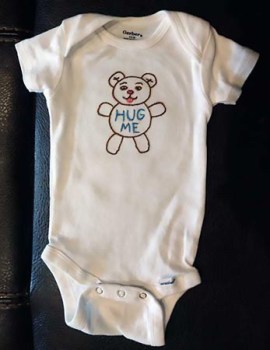
A lot has happened since my last post. I had a baby! It’s probably no surprise, then, that I’m going to be sharing some baby-related crafts these days. Here is my first one: a free embroidery pattern that’s ideal for a baby onesie. The example shown was stitched onto a pre-made white Gerber onesie using a 4-inch embroidery hoop. The entire project took me less than one weekend to complete.

Click here to download a PDF of the “Hug Me Teddy Bear” pattern.
or
Click here to download a PDF of the pattern as a mirror image.


Tips and Techniques for Stitching Your Baby Onesie Embroidery Pattern

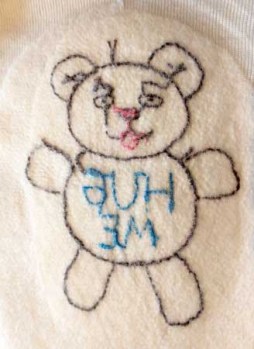
hug me bear back image

I put two layers of lightweight iron-on interfacing on the inside of the fabric – once BEFORE I start to stitch to stabilize the fabric, and then a second time AFTER I’m done stitching. The second layer of interfacing both keeps stitching in place and also ensures that the fabric won’t chafe against the skin.

With the first layer of interfacing in place, I stitched the entire pattern using stem stitch, except for the pink center of the nose, which uses satin stitch. Don’t worry about attempting any satin stitch for the eye pupils. They’re too small for that. Instead, simply do two small stitches right next to each other. That will be plenty.

I opted for stem stitch instead of back stitch for two reasons. First, I like stem stitch better for sharp curves (like around the eyes and tongue, for example). Second, and more importantly, stem stitch makes a much neater back side for the stitching. And when it comes to potential chafing against my baby’s skin, I want as little thread on the back of the fabric as possible.


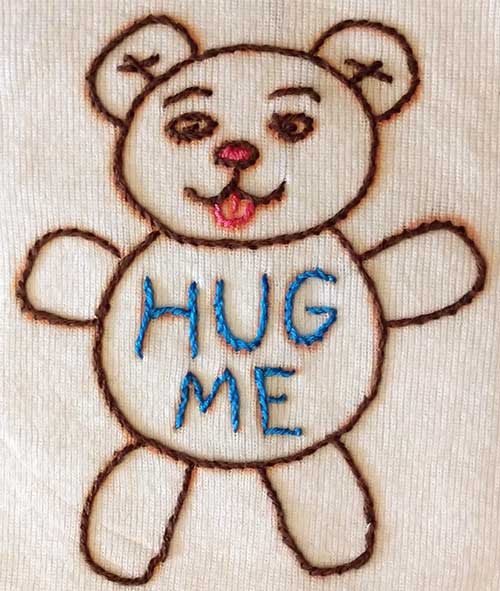
Here is a closer image of the front of the embroidery. (Please pardon the wrinkles in the fabric… I hadn’t ironed out the crease from the embroidery hoop when I took this photo.)

hug me bear front image

My color choices, as you can see in the picture, are dark brown throughout (including the stem stitch outline of the nose), medium pink for the tongue and center of the nose, and turquoise for the “Hug Me” letters.

If you try out this pattern, I’d love to know what colors you chose to use. Share a picture of your stitching in the comments!


The Rules for This Pattern…

Free embroidery pattern hug me bear

All patterns found on Crafting Shapes are fully my own designs unless specifically stated otherwise.

You are not allowed to… sell any part of this free embroidery Hug Me Teddy Bear pattern in part or as a whole, nor may you sell the finished creation that results from this or any other pattern on Crafting Shapes.

You are welcome to… print, duplicate, and create this project for your personal, non-commercial use. You are also welcome to give finished projects as gifts to others or donate them for free to charitable causes.

If you choose to share this free embroidery pattern online (such as on Pinterest or through your own blog), please link directly to this post to help support my ability to create future free patterns for all to enjoy. (Do not copy/paste the pattern into your own blog, for example.)